Every ecommerce store owner reaches the same crossroads eventually. Traffic is not growing the way it should, competitors are ranking above you for the keywords that matter most, and someone suggests investing in better SEO tools. The immediate question that follows is almost always the same: do you really need to pay for SEO software, or can free tools get the job done? In 2026, that question has a more nuanced answer than ever before, and getting it right can meaningfully impact how efficiently your store grows in organic search.
This article breaks down what free and paid SEO tools each bring to ecommerce, where the real gaps lie, and how to make a decision that aligns with your store’s current stage and ambitions.
Why SEO Tools Matter More for Ecommerce in 2026
Ecommerce SEO has evolved considerably. Google’s systems now evaluate product pages with greater scrutiny, looking beyond keyword placement to assess page experience, structured data accuracy, review signals, and how well the content serves buyer intent. Category pages, product descriptions, and even site architecture all carry ranking weight in ways that require systematic analysis to optimise effectively.
The result is that guesswork and manual monitoring no longer cut it for stores competing beyond the most niche corners of the market. Tools, whether free or paid, have become a practical necessity rather than an optional upgrade. The real question is not whether to use them, but which tier genuinely matches your situation.
For businesses operating across the UAE and Gulf region, understanding the digital marketing landscape and how search tools feed into broader strategy is particularly important. Ecommerce in this market has grown sharply, and the brands gaining ground are those treating SEO as a data-driven discipline rather than an afterthought. You can explore how digital marketing strategies are evolving across the region to better understand the competitive environment your store operates in.
What Free SEO Tools Can Realistically Do
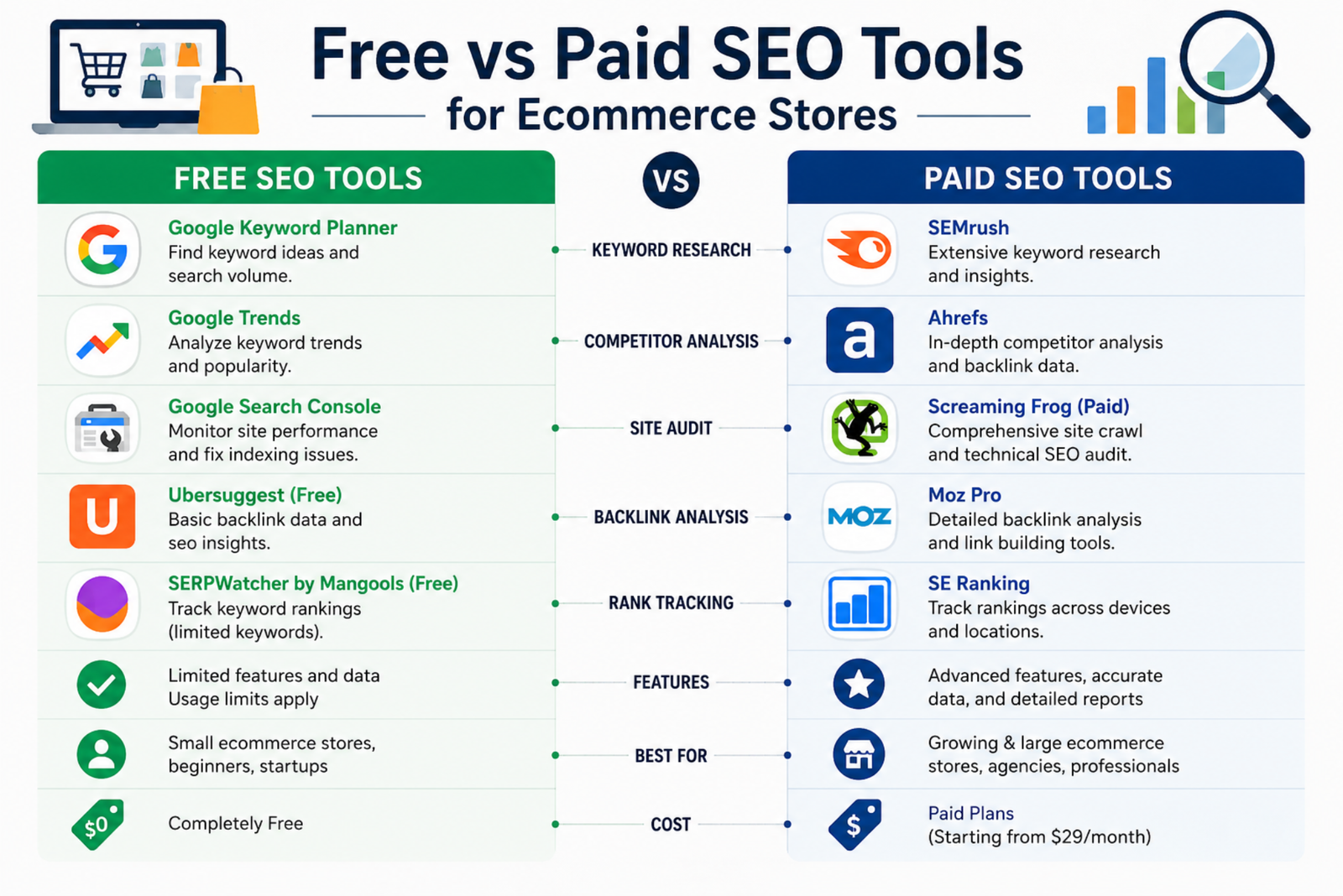
The free SEO ecosystem in 2026 is genuinely strong at the foundational level. Several tools that cost nothing provide data and capabilities that would have required significant investment just a few years ago. For a store in its early stages or one operating in a low-competition niche, these tools can form a functional and productive workflow:

Google Search Console — The single most important free tool for any ecommerce store. It shows which queries drive impressions and clicks, identifies crawl errors, flags Core Web Vitals issues, and gives direct insight into how Google is indexing your pages. No paid tool replaces it; they supplement it.
Google Analytics 4 — Provides comprehensive traffic reporting, ecommerce conversion tracking, funnel analysis, and audience behaviour data at no cost. Combined with Search Console, it gives you a solid picture of how users arrive and what they do on your store.
Google Keyword Planner — Primarily designed for paid search advertisers, but useful for directional keyword volume data, especially for identifying seasonal demand trends relevant to your product categories.
Ubersuggest Free Tier — Offers limited daily keyword lookups, basic site audits, and competitor traffic overviews. Functional for occasional research, though daily usage limits cap its utility quickly.
Screaming Frog SEO Spider (Free) — Crawls up to 500 URLs and identifies technical issues including broken links, duplicate titles, missing meta descriptions, and redirect chains. Highly valuable for smaller stores.
Google Trends — Excellent for understanding when demand for specific products peaks, which can inform both content planning and inventory decisions for ecommerce operators.
These tools, used together with consistency and clear intent, can support a meaningful organic growth strategy for stores that are patient and methodical. The limitation is not capability at the entry level but depth, scale, and the time required to manually piece insights together across multiple platforms.
Where Free Tools Reach Their Ceiling
Free SEO tools begin to show their limits as soon as ecommerce ambitions grow beyond basic optimisation. The gaps are most visible in the areas that drive competitive advantage at scale:
Backlink intelligence — Understanding who links to your competitors, what their domain authority looks like, and which pages on your own site are earning or losing links requires paid-level data. Free tools offer snapshots; paid tools offer the full picture.
Rank tracking at volume — Monitoring rankings for hundreds or thousands of product pages manually through Search Console is slow and imprecise. Paid tools automate daily position tracking across markets and device types.
Content gap analysis — Identifying which keywords your competitors rank for that you do not is one of the highest-ROI activities in ecommerce SEO. This type of analysis requires comprehensive keyword databases that free tools simply do not maintain.
Keyword difficulty scoring — Without reliable difficulty metrics, you risk spending months targeting keywords that are essentially unreachable at your site’s current authority level. Paid tools provide this scoring with meaningful accuracy.
Large-scale site audits — A catalogue of 1,000 product pages needs a crawl tool that can handle the volume, surface issue patterns across the whole site, and prioritise fixes by impact. Free crawlers cap URL limits and lack the reporting depth to do this well.
What Paid SEO Platforms Actually Deliver
The leading paid SEO platforms, Ahrefs, Semrush, Moz Pro, and similar tools, justify their subscription cost through data quality, scale, and the speed at which insights can be turned into decisions. For ecommerce stores competing seriously, these platforms shift the nature of SEO work from reactive to proactive.
The most impactful advantages of paid tools for ecommerce include integrated keyword research with intent classification, automated rank tracking dashboards that surface movement at a glance, competitor traffic estimates that inform your strategic benchmarking, historical data that shows when and why your rankings shifted, and backlink analysis that identifies link-building opportunities worth pursuing. Many platforms also now include AI-assisted content briefs and internal linking recommendations that reduce the time senior teams spend on operational SEO tasks.
For store owners who are exploring how to structure their digital presence more effectively, understanding the relationship between business growth and digital investment can help contextualise why SEO tooling is often one of the first areas where scaling brands increase their spend.
Head-to-Head: Free vs Paid SEO Tools for Ecommerce
| Capability | Free Tools | Paid Tools |
|---|---|---|
| Keyword Research | Basic volume and suggestions only | Full difficulty scores, intent data, and clustering |
| Backlink Analysis | Very limited or not available | Deep competitor and own-site backlink analysis |
| Technical Site Audit | Up to 500 URLs (Screaming Frog free) | Unlimited crawl with prioritised issue reporting |
| Rank Tracking | Manual via Search Console | Automated daily tracking across pages and markets |
| Competitor Analysis | Surface level only | Traffic, top keywords, content gaps, and ad data |
| Content Gap Analysis | Not available | Full gap reports against multiple competitors |
| Historical Data | Limited via Search Console (16 months) | Multi-year historical ranking and traffic data |
| Reporting and Dashboards | Manual compilation required | Automated dashboards and scheduled reporting |
| Monthly Cost | Free | Approximately $99 to $500+ depending on plan |
How to Decide What Your Ecommerce Store Needs
The right answer depends on three variables: your current revenue, the competitiveness of your niche, and how actively you are investing in SEO as a growth channel. Rather than defaulting to either extreme, use the following framework to guide your decision.
Free tools are the right starting point when:
- Your store is pre-revenue or generating less than $2,000 to $3,000 per month
- You are in a clearly defined niche with limited direct competition in search
- Your product catalogue has fewer than 200 to 300 SKUs
- You are still building foundational SEO knowledge and experimenting with strategy
- Budget is a genuine constraint and every recurring cost must show near-term return
Paid tools become justified when:
- Your store generates enough monthly revenue to absorb a $100 to $200 tool investment
- Competitors with strong domain authority are consistently outranking you for high-intent keywords
- Your catalogue spans hundreds of product and category pages that require systematic monitoring
- You are producing content at volume and need keyword and topic data to work efficiently
- You run paid advertising alongside SEO and need integrated data to inform both channels
Many growing ecommerce brands take a hybrid approach: maintaining free tools like Google Search Console and Analytics as permanent fixtures while subscribing to a paid platform for quarterly strategic audits and competitive research. This avoids paying for features that only make sense at scale while still accessing the depth of data needed for informed decisions.
If you are exploring which free SEO tools are worth integrating into your workflow before committing to a paid subscription, it is worth auditing your current gap between what your free tools show and what decisions you cannot yet make confidently. That gap is the clearest signal of whether an upgrade is warranted.
Pricing Context: What Paid SEO Tools Cost in 2026
| Tool | Entry Plan (Monthly) | Mid-Tier Plan (Monthly) | Best For |
|---|---|---|---|
| Semrush | ~$139 | ~$249 | Content strategy, keyword research, competitor tracking |
| Ahrefs | ~$129 | ~$249 | Backlink analysis, rank tracking, site audits |
| Moz Pro | ~$99 | ~$179 | Local SEO, rank tracking, on-page optimisation |
| Ubersuggest (Paid) | ~$29 | ~$49 | Budget-conscious stores needing basic paid features |
Note: Pricing varies by billing cycle, and most platforms offer meaningful discounts for annual subscriptions. Free trials of 7 to 14 days are typically available, which is enough time to run a competitive audit and assess whether the data justifies the cost for your specific store.
Building a Practical SEO Stack for Ecommerce
Regardless of where you land on the free versus paid decision, certain tools belong in every ecommerce SEO stack. Google Search Console and Google Analytics 4 are non-negotiable and should be configured and actively monitored from the moment your store launches. They provide data that no third-party tool replaces and are often the first place major issues surface.
Layer supplementary tools based on your actual gaps. A store with strong content output but weak technical health benefits more from a paid crawler than from a keyword research subscription. A store with good technical foundations but limited visibility in competitive categories benefits more from a keyword intelligence platform. Matching tools to genuine needs prevents overspending on features that sit unused. [Insert relevant reference link here]
The most important thing is consistency. A free tool used well and acted on regularly delivers more value than a premium platform subscription that produces reports nobody reads or implements. SEO tools only generate ROI when their insights drive actual changes on your site.
Frequently Asked Questions
Can a small ecommerce store rank well using only free SEO tools?
Yes, in low to moderate competition niches it is entirely possible. Google Search Console, Analytics 4, and Screaming Frog’s free version together cover the essentials. The limitation comes at scale or when competing against established domains with strong authority and comprehensive content strategies.
Which free SEO tool is most useful for ecommerce product pages?
Google Search Console is the most directly useful. It shows exactly which queries are bringing impressions to your product pages, which pages have click-through rate issues, and which are experiencing indexing problems. It is the closest thing to free competitive intelligence that Google itself provides.
Is it worth paying for multiple SEO tools or should I pick one?
For most ecommerce stores, one strong paid platform covers the majority of needs. Ahrefs and Semrush both offer broad enough feature sets that a second platform adds limited marginal value. The exception is stores with specific technical SEO challenges that require a dedicated crawler like Screaming Frog or Sitebulb alongside a general research platform.
How long before paid SEO tools produce a measurable return?
This depends entirely on how insights are implemented. Stores that act quickly on keyword gaps and technical fixes can see meaningful ranking improvements within two to three months. Tools accelerate the identification of opportunities; execution speed and quality determine when those opportunities translate to traffic and revenue.
The free versus paid SEO tools debate in 2026 does not have a single universal answer, but it does have a clear framework. Free tools are powerful, genuinely capable, and the right starting point for most ecommerce stores. They become limiting when your catalogue grows, your competition intensifies, or your strategic decisions require data that free platforms simply cannot provide at the depth needed.
Paid platforms deliver real value when they are matched to genuine gaps and used consistently to drive decisions. The worst outcome is paying for a subscription that sits underused or staying with free tools past the point where their limitations are costing you ranking opportunities. Evaluate where your store is now, identify what data you are missing, and make the call based on evidence rather than assumption. That approach will always serve your ecommerce growth better than defaulting to either extreme.
Related Reading: The Growing Need for Reliable Gold Detection Technology — full guide
Related Reading: What Are SEO Tools for Ecommerce Stores and Which Features Matter Most in 2026?